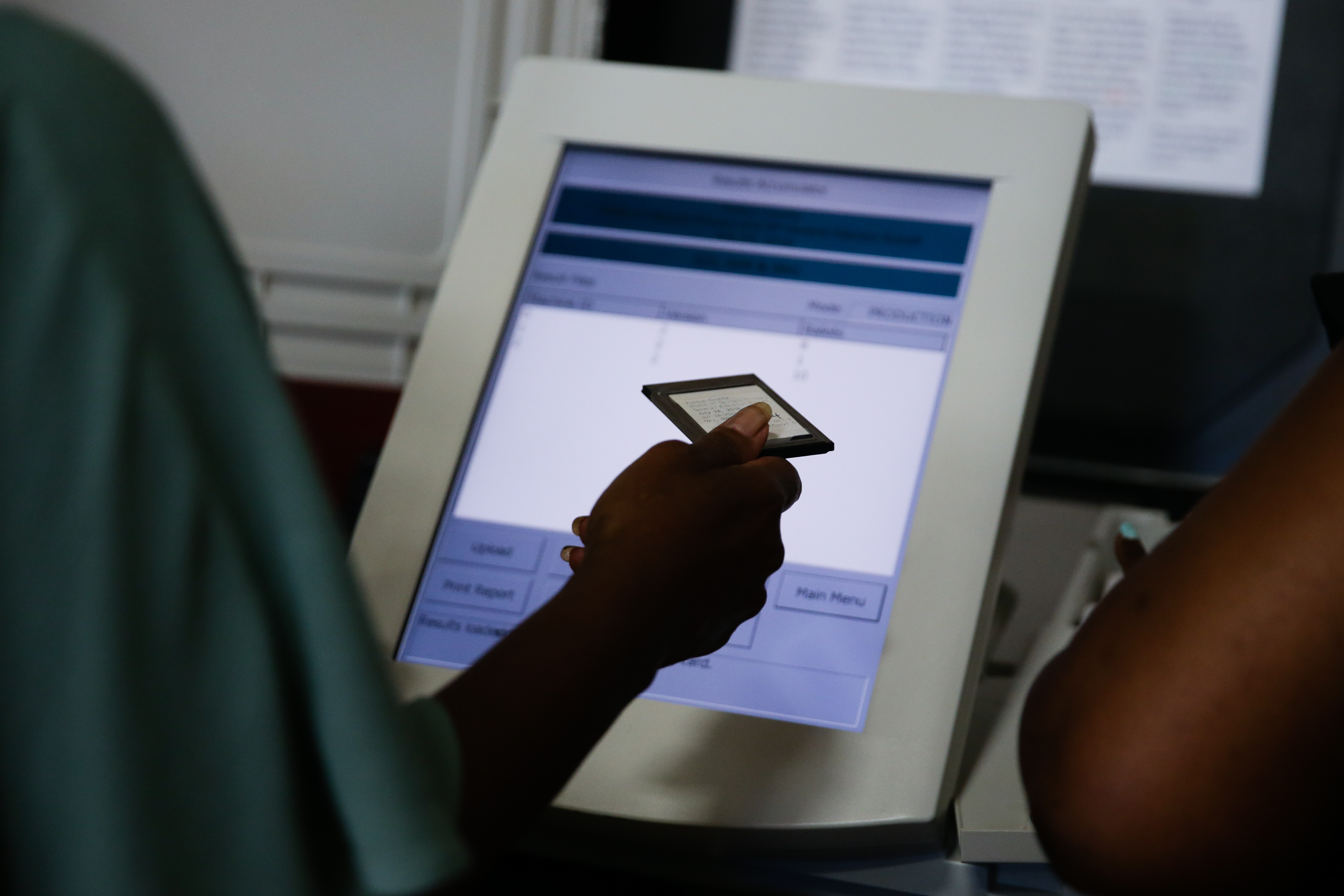
Enlarge/ An election official holds an electronic voting machine memory card following the Georgia primary runoff elections at a polling location in Atlanta, Georgia, US, on Tuesday, July 24, 2018.
Elijah Nouvelage/Bloomberg via Getty Images
Election security advocates scored a major victory on Thursday as a federal judge issued a 153-page ruling ordering Georgia officials to stop using its outdated electronic voting machines by the end of the year. The judge accepted the state’s argument that it would be too disruptive to switch to paper ballots for municipal elections being held in November 2019. But she refused to extend that logic into 2020, concluding that the state had plenty of time to phase out its outdated touchscreen machines before then.
The state of Georgia was already planning to phase out its ancient touchscreen electronic voting machines in favor of a new system based on ballot-marking machines. Georgia hopes to have the new machines in place in time for a presidential primary election in March 2020. In principle, that switch should address many of the critics’ concerns.
The danger, security advocates said, was that the schedule could slip and Georgia could then fall back on its old, insecure electronic machines in the March primary and possibly in the November 2020 general election as well. The new ruling by Judge Amy Totenberg slams the door shut on that possibility. If Georgia isn’t able to switch to its new high-tech system, it will be required to fall back on a low-tech system of paper ballots rather than continue using the insecure and buggy machines it has used for well over a decade.
Alex Halderman, a University of Michigan computer scientist who served as the plaintiffs’ star witness in the case, hailed the judge’s ruling.
“The court’s ruling recognizes that Georgia’s voting machines are so insecure, they’re unconstitutional,” Halderman said in an email to Ars. “That’s a huge win for election security that will reverberate across other states that have equally vulnerable systems.”
Georgia’s voting technology is deeply flawed
Totenberg’s ruling is 153 pages long because it presents a mountain of evidence that Georgia’s touchscreen voting machines—as well as back-office software the state uses to manage voter registrations, design ballots, and count votes—are outdated and insecure.
Georgia is still using Diebold Accuvote TSX touchscreen machines whose hardware and software date back to around 2005. In 2006 and 2007, security researchers discovered numerous security vulnerabilities in these machines—problems serious enough to cause California to decertify them from use in state elections.
After one 2006 report, Totenberg writes, “Diebold was forced to create a security patch for the vulnerable TSX software.” Yet incredibly, “there is no evidence that Georgia ever implemented the software patch or made any upgrades to protect the integrity of its DRE machines,” Totenberg says.
The security problems found by those early researchers were serious. Not only can someone with physical access to the machine install vote-stealing malware, it’s also possible to deliver such malware using viruses that spread from machine to machine on the memory cards election workers use to load ballot information onto them. Hence, a malicious actor with a few minutes’ access to a single machine could potentially hack dozens or even hundreds of machines.
These concerns seemed somewhat theoretical when they were first raised around 2006. After all, who would want to hack an election? But they’ve been given added urgency after revelations that the Russian government actively probed state election systems—including in Georgia—in 2016.
Not actually air-gapped
Besides hacking voting machines directly, another way someone could compromise an election would be to first hack the office computers of election officials. Officials use these computers to create ballot definition files that are later transferred to voting machines via memory cards. Here too, there’s a risk that malware could ride along with the ballot files and infect machines.
Georgia election officials dismissed these concerns. In 2018 testimony before Judge Totenberg, official Michael Barnes insisted that the computers used to design electronic ballots were air-gapped from the Internet, making it impossible for remote attackers to compromise them. But subsequent testimony made it clear that this was wrong. In reality, Totenberg writes, ballots were designed “on public-facing internet-connected desktop computers of the individual ballot builders, then copied over from the public facing computer onto a ‘lockable’ USB drive for transfer to the ‘air-gapped’ system.”
In court testimony, Halderman pointed out that this setup isn’t actually secure. “Air-gapping” a computer does no good if people are regularly transferring files to it from Internet-connected computers.
It gets worse. In 2016, a Georgia-based security researcher discovered that Kennesaw State University’s Center for Election Systems, which has a contract to help Georgia manage its elections, had a massive cache of sensitive election-related documents—including private voter data and passwords for election systems—publicly available on its website for anyone to download. After being notified of the breach, it took officials months to remove the sensitive information from the website.
Many voters reported problems with the machines
Meanwhile, dozens of ordinary Georgia voters told the court that they had experienced problems with Georgia’s touchscreen machines. Totenberg describes one voter’s experience:
Teri Adams described that when she voted at the Bleckley County Courthouse and selected candidate Stacey Abrams for governor on the DRE screen, she noticed that her designated selection was listed as Brian Kemp on the review screen. She tried to vote for Abrams a second time, but the review screen again showed Kemp as her chosen candidate. Ms. Adams cast her ballot on the third try when her selection in the governor’s race remained Abrams. Adams reported her problems on “machine number 2” to the poll workers whose only response was “did it take your vote?”
Adams was hardly an isolated case. A number of voters reported that it took two or three tries to ensure that a voting machine was choosing their preferred candidate.
Is this evidence that hackers were tampering with the election? Probably not. It seems more likely that Georgia’s touchscreen machines are just old and poorly designed. Someone who hacked the machines in order to steal the election wouldn’t have any reason to alarm voters by showing the stolen vote on the screen—they could show the voter’s correct choice on the screen while recording a different result in the electronic record.
But the fact that so many voters have reported problems with the machines is a problem in its own right. A mis-recorded vote is a problem regardless of whether it was the result of hacking, malfunctioning equipment or just a badly designed user interface. And there’s now ample evidence that touchscreen machines are a less effective way to record voters’ choices than a traditional paper ballot.
Georgia must stop using its machines after 2019
Judge Totenberg had all of these problems in mind as she was deciding what to do with the lawsuit. She was convinced by the plaintiffs’ argument that Georgia’s current election system was fatally flawed and needed to be overhauled—and that a hand-marked paper ballot was the gold standard for secure and reliable voting.
At the same time, she took seriously warnings from the state of Georgia that an abrupt shift to paper ballots could cause more disruption than it was worth. The issue was complicated by the fact that Georgia’s legislature recently passed legislation directing that the state develop a new election system based on ballot-marking devices—electronic voting machines that print out a paper ballot the voter can examine.
Georgia has signed a contract with a vendor for these new machines and plans to start testing them in a few cities in this November’s elections. The state aims to start rolling the new system out statewide in time for next March’s presidential primary. Under that timeline, the state would stop using its current, insecure machines before the end of the year.
The problem, critics point out, is that the state may not be able to roll out the new system in time for next March’s election. Experts testified that Georgia has set an unusually aggressive timeline for standing up a completely new election system, and this creates a risk that the schedule could slip. In that case, Georgia’s most likely fallback would be to continue using its existing touchscreen machines for the spring primary election—and possibly even the November 2020 general election.
So Judge Totenberg decided to split the difference. She denied the plaintiffs’ request to force Georgia to begin using paper ballots in the November 2019 election. She accepted the state’s argument that it would be a waste of resources to set up a paper-based system that will only be used in a single election—and that such an order could distract from efforts to develop the new system for 2020.
However, she also ordered the state not to use its old touchscreen machines as a fallback for elections in 2020. If the new ballot-marking devices aren’t ready by March, the state will be required to use hand-marked paper ballots instead.
People are finally listening to computer scientists
The order is an important ruling for voters in Georgia, who won’t have to worry about outdated equipment failing to accurately record their vote in 2020. But the ruling is also an important milestone in the broader debate over voting machine security. Judge Totenberg’s ruling is a strong endorsement of the consensus of computer security experts about the dangers of computer-based voting. Princeton computer scientist Andrew Appel put it well in a report quoted by Totenberg:
All digital information—such as ballot definitions, voter choice records, vote tallies, or voter registration lists—is subject to malicious alteration; there is no technical mechanism currently available that can ensure that a computer application—such as one used to record or count votes—will produce accurate results; testing alone cannot ensure that systems have not been compromised; and any computer system used for elections—such as a voting machine or e-pollbook—can be rendered inoperable.
As a result of these arguments, most computer scientists favor voting via a hand-marked paper ballot. They believe that computerized optical scanners are a reasonable way to speed up the vote-counting process provided that a state also provides for routine post-election audits that hand count a random sample of ballots to verify the accuracy of the machine count.
Federal legislation to strengthen election security has been blocked by Senate Majority Leader Mitch McConnell. But that doesn’t preclude changes at the state level, with the courts spurring states along in the most egregious cases. Totenberg’s clear and thorough ruling will give opponents of electronic voting machines a bit of extra momentum as they race to decommission as many electronic voting machines as possible before the November 2020 presidential election.
Monthly Web Development Update 8/2019: Strong Teams And Ethical Data Sensemaking
Anselm Hannemann
What’s more powerful than a star who knows everything? Well, a team not made of stars but of people who love what they do, stand behind their company’s vision and can work together, support each other. Like a galaxy made of stars — where not every star shines and also doesn’t need to. Everyone has their place, their own strength, their own weakness. Teams don’t consist only of stars, they consist of people, and the most important thing is that the work and life culture is great. So don’t do a moonshot if you’re hiring someone but try to look for someone who fits into your team and encourages, supports your team’s values and members.
In terms of your own life, take some time today to take a deep breath and recall what happened this week. Go through it day by day and appreciate the actions, the negative ones as well as the positive ones. Accept that negative things happen in our lives as well, otherwise we wouldn’t be able to feel good either. It’s a helpful exercise to balance your life, to have a way of invalidating the feeling of “I did nothing this week” or “I was quite unproductive.” It makes you understand why you might not have worked as much as you’re used to — but it feels fine because there’s a reason for it.
News
Three weeks ago we officially exhausted the Earth’s natural resources for the year — with four months left in 2019. Earth Overshoot Day is a good indicator of where we’re currently at in the fight against climate change and it’s a great initiative by people who try to give helpful advice on how we can move that date so one day in the (hopefully) near future we’ll reach overshoot day not before the end of the year or even in a new year.
Chrome 76 brings the prefers-color-scheme media query (e.g. for dark mode support) and multiple simplifications for PWA installation.
UI/UX
There are times to use toggle switches and times not to. When designers misuse them, it leads to confused and frustrated users. Knowing when to use them requires an understanding of the different types of toggle states and options.
Some experiments sound silly but in reality, they’re not: Chris Ashton used the web for a day on a 50MB budget. In Zimbabwe, for example, where 1 GB costs an average of $75.20, ranging from $12.50 to $138.46, 50MB is incredibly expensive. So reducing your app bundle size, image size, and website cost are directly related to how happy your users are when they browse your site or use your service. If it costs them $3.76 (50MB) to access your new sports shoe teaser page, it’s unlikely that they will buy or recommend it.
BBC’s Toby Cox shares how they ditched iframes in favor of ShadowDOM to improve their site performance significantly. This is a good piece explaining the advantages and drawbacks of iframes and why adopting ShadowDOM takes time and still feels uncomfortable for most of us.
Yes, prefers-reduced-motion isn’t super new anymore but still heavily underused on the web. Here’s how to apply it to your web application to serve a user’s request for reduced motion.
HTML & SVG
With Chrome 76 we get the loading attribute which allows for native lazy loading of images just with HTML. It’s great to have a handy article that explains how to use, debug, and test it on your website today.
No more custom lazy-loading code or a separate JavaScript library needed: Chrome 76 comes with native lazy loading built in. (Image credit)
Here’s a technical analysis of the Capital One hack. A good read for anyone who uses Cloud providers like AWS for their systems because it all comes down to configuring accounts correctly to prevent hackers from gaining access due to a misconfigured cloud service user role.
SmashingMag launched a print and eBook magazine all about ethics and privacy. It contains great pieces on designing for addiction, how to improve ethics step by step, and quieting disquiet. A magazine worth reading.
Work & Life
“For a long time I believed that a strong team is made of stars — extraordinary world-class individuals who can generate and execute ideas at a level no one else can. These days, I feel that a strong team is the one that feels more like a close family than a constellation of stars. A family where everybody has a sense of predictability, trust and respect for each other. A family which deeply embodies the values the company carries and reflects these values throughout their work. But also a family where everybody feels genuinely valued, happy and ignited to create,” said Vitaly Friedman in an update thought recently and I couldn’t agree more.
How do you justify a job in a company that has a significant influence on our world and our everyday lives and that not necessarily with the best intentions? Meredith Whittaker wrote up her story of starting at Google, having an amazing time there, and now leaving the company because she couldn’t justify it anymore that Google is using her work and technology to get involved in fossil energy business, healthcare, governance, and transportation business — and not always with the focus on improving everyone’s lives or making our environment a better place to live in but simply for profit.
Synchronous meetings are a problem in nearly every company. They take a lot of time from a lot of people and disrupt any schedule or focused work. So here’s how Buffer switched to asynchronous meetings, including great tips and insights into why many tools out there don’t work well.
Actionable advice is what we usually look for when reading an article. However, it’s not always possible or the best option to write actionable advice and certainly not always a good idea to follow actionable advice blindly. That’s because most of the time actionable advice also is opinionated, tailored, customized advice that doesn’t necessarily fit your purpose. Sharing experiences instead of actionable advice fosters creativity so everyone can find their own solution, their own advice.
Sam Clulow’s “Our Planet, Our Problem” is a great piece of writing that reminds us of who we are and what’s important for us and how we can live in a city and switch to a better, more thoughtful and natural life.
Climate change is a topic all around the world now and it seems that many people are concerned about it and want to take action. But then, last month we had the busiest air travel day ever in history. Airplanes are accountable for one of the biggest parts of climate active emissions, so it’s key to reduce air travel as much as possible from today on. Coincidentally, this was also the hottest week measured in Europe ever. We as individuals need to finally cut down on flights, regardless of how tempting that next $50-holiday-flight to a nice destination might be, regardless of if it’s an important business meeting. What do we have video conferencing solutions for? Why do people claim to work remotely if they then fly around the world dozens of times in their life? There are so many nice destinations nearby, reachable by train or, if needed, by car.
Leo Babauta shares a tip on how to stop overthinking by cutting through indecision. We will never have the certainty we’d like to have in our lives so it’s quite good to have a strategy for dealing with uncertainty. As I’m struggling with this a lot, I found the article helpful.
The ethical practices that can serve as a code of conduct for data sensemaking professionals are built upon a single fundamental principle. It is the same principle that medical doctors swear as an oath before becoming licensed: Do no harm. Here’s “Ethical Data Sensemaking.”
Paul Hayes shares his experience from trying to live plastic-free for a month and why it’s hard to stick to it. It’s surprising how shopping habits need to be changed and why you need to spend your money in a totally different way and cannot rely on online stores anymore.
Oil powers the cars we drive and the flights we take, it heats many of our homes and offices. It is in the things we use every day and it plays an integral role across industries and economies. Yet it has become very clear that the relentless burning of fossil fuels cannot continue unabated. Can the world be less reliant on oil?
Disney and Charter Communications are teaming up to fight account sharing in an attempt to prevent multiple people from using a single account to access streaming video services.
The battle against account sharing was announced as Disney and the nation’s second-biggest cable company struck a new distribution agreement involving Disney’s Hulu, ESPN+, and the forthcoming Disney+. Customers could still buy those online services directly from Disney, but the new deal would also let them make those purchases through Charter’s Spectrum TV service.
ARS TECHNICA
This story originally appeared on Ars Technica, a trusted source for technology news, tech policy analysis, reviews, and more. Ars is owned by WIRED’s parent company, Condé Nast.
If you buy a Disney service through Charter, be aware that the companies will work together to prevent you from sharing a login with friends. Disney and Charter said in their announcement Wednesday that they have “agreed to work together on piracy mitigation. The two companies will work together to implement business rules and techniques to address such issues as unauthorized access and password sharing.”
In addition to streaming services, the deal will let Charter continue carrying Disney-owned TV channels on its cable service. That includes ABC, the various Disney and ESPN channels, FX, National Geographic, and more.
“This agreement will allow Spectrum to continue delivering to its customers popular Disney content, makes possible future distribution by Spectrum of Disney streaming services, and will begin an important collaborative effort to address the significant issue of piracy mitigation,” Charter Executive VP Tom Montemagno said.
The announcement didn’t say exactly how the companies will fight account sharing. We asked Charter for technical details on how it’ll work and about whether this will result in more personal customer data being shared between Charter and Disney. Charter did not answer any of our questions, saying, “we don’t have details to share at this time.”
We sent the same questions to Disney and will update this article if we get any answers.
Charter CEO complained about account sharing
The crackdown could target people who use Charter TV account logins to sign into Disney services online. Charter CEO Tom Rutledge has complained about account sharing several times over the past few years while criticizing TV networks for not fully locking down their content.
“There’s lots of extra streams, there’s lots of extra passwords, there’s lots of people who could get free service,” Rutledge said at an industry conference in 2017. He argues that password sharing has helped people avoid buying cable TV. ESPN has also complained about account sharing, calling it piracy.
Another possibility is that Charter could monitor usage of its broadband network to help Disney fight account sharing. For example, Disney could track the IP addresses of users signing in to its services, and Charter could match those IP addresses to those of its broadband customers. Charter has plenty of leeway to share its customers’ private browsing data because the Republican-controlled Congress eliminated broadband privacy rules in 2017.
Customers could use VPN services to attempt to avoid detection, though.
Charter has 15.8 million residential TV customers nationwide, making it the second-biggest cable TV service after Comcast. But it lost 400,000 video customers in the past year. Charter’s broadband service has gone in the other direction, rising from 23.1 million to 24.2 million residential customers in the past year.
In contrast to Charter and Disney, Netflix and HBO haven’t cared as much about account sharing.
Netflix and HBO take less strict approach
Sharing a Netflix account “with individuals beyond your household” does violate Netflix’s terms of use, but the restriction isn’t heavily enforced. “Password sharing is something you have to learn to live with, because there’s so much legitimate password sharing, like you sharing with your spouse, with your kids,” Netflix CEO Reed Hastings said in 2016.
Now-former HBO CEO Richard Plepler once said that password sharing is a “terrific marketing vehicle for the next generation of viewers” and that “we’re in the business of creating addicts.” (Plepler left HBO in February, less than a year after AT&T bought HBO owner Time Warner.)
Netflix, HBO, and the Disney-owned Hulu all limit the number of concurrent streams on each account, however. That doesn’t prevent account sharing entirely, but such a policy can make it inconvenient to share an account with a bunch of friends.
In the race toward electrification, some car companies are more motivated than others. Take Volkswagen: Still reeling from the fallout of its Dieselgate scandal, the German giant’s various arms are announcing, developing, and trying to sell EVs at a dizzying pace, from Audi’s E-Tron SUV to Porsche’s Taycan, to a slew of VWs in the pipeline. And funnily enough, VW’s rush to the future has put me a bit back in time, and into a dune buggy.
This swoopy green sand machine, called the ID Buggy, isn’t destined for production, unlike VW’s revived-as-electric Microbus. The concept’s mission is to prove the flexibility of VW’s Modularer E-Antriebs-Baukasten, or MEB, or modular electric car platform. The idea is to that, like the old Beetles enthusiasts turned into dune buggies, today’s electrics can become just about anything.
Get the top electric car news in your inbox every Monday. Sign up here!
A few months after showing the concept at the Geneva Motor Show, VW brought the ID Buggy to Monterey Car Week, perhaps the year’s greatest event for automotive enthusiasts. Sadly, my drive was short, speed-limited, and restricted to pavement, due to the Monterey’s anti-fun ordinances and the fact that this is still a concept car and not quite ready for full-on dune bashing. But it was nevertheless revealing about the potential—and limits—of future EV manufacturing.
“We wanted to know how make electromobility more popular, and one of those solutions became allowing third-party manufacturers to license the platform,” says Jochen Tekotte, VW’s communication director for its electrified models. “In the 1960s people took the Beetle and built onto it, including most famously dune buggies like the Meyers Manx.”
The ID Buggy’s 228 pound-feet of torque and 201 horsepower are plenty to spin up some dirt—or sand.
Eric Adams
The Manx, created by Bruce Meyers, saw high-profile action in Steve McQueen and Elvis Presley films, and became a staple of California car and beach culture. Volkswagen recently commissioned a new one for themselves from Meyers. The small, gas-powered, open-top ride had a four-speed manual transmission directing power from the Beetle engine to the rear wheels. Driving it up and down 17-Mile Drive in Monterey was a thrill. Steering was mushy at best, the transmission felt suicidal, and the wipers didn’t so much move a molecule of mist from the windshield. But it was light and small and quick, and it felt magnetically drawn to the nearby, woefully off-limits dunes. Then it was time to drive VW’s electric version.
The ID Buggy pulls away smoothly and silently, and rips briskly up to 25 mph. That was enough to motor down the road at a comfortable casual pace, and the 228 lb-ft of torque from the 150 kW, 201-hp motor was enough to spin up some dirt when mashing the pedal from a stop. Steering felt precise and silky, aided by the car’s powerful electric motors. The waterproof interior is roomy and comfortable, the controls an exercise in minimalism. The foot pedals have familiar digital-media symbols representing their respective functions—press “play” to go, “pause” to stop. It’s also fully weather-sealed and ready to go splashing through the surf.
The connection to the Manx is mostly in spirit. The original buggy is a high-riding off-roader that weighs around 1,500 pounds, built on the cheap using the chassis, engines, and other components from the Beetle. Agile and durable, they’re renowned for their fun, energetic vibes. The ID Buggy weighs around 4,400 pounds, thanks to its battery and all the structural hardware required to make modern cars safe. Still, it can shoot up to 62 mph in a respectable-enough 7.2 seconds and drive for a full 155 miles on a single charge. A production version matching these specs could top out at 99 mph.
But that spirit of fun remained, thanks to the smoothness, the open-air aura, a suspension engineered for off-roading, and its responsiveness. The ID Buggy more or less looks the part, and anyway, the only one who can build a true electric Manx is probably Meyers Manx Inc., itself.
Which is fine, because the point of this exercise isn’t to rebirth the Manx but to show that that the MEB electric platform on which this concept is built can fit any number of applications, including a slightly bloated but still fun dune buggy. Want to replicate the looseness of rear-wheel-drive? Flip a switch. Want to bail yourself out of trouble on the trail? Hit all-wheel-drive. Ultimately, there might be a day when electrics become as heavily customized as similarly versatile cars were in the ’60s and ’70s.
So while VW has no immediate intention to produce the ID Buggy itself, it is hoping aftermarket builders might take on the challenge of customizing the MEB Platform. It’s already gaining some traction in this respect: Ford just licensed the platform to build a small EV for its European market. No word yet on whether it’ll be any fun.
Ikea
Ikea is formalizing what has recently become all too obvious: the company is making a major bet on smart home tech as a source of new revenue. To do this, Ikea announced that it will invest heavily in a new “Ikea Home smart” business unit with end-to-end responsibility for its burgeoning portfolio of smart devices. With access to 780 million shoppers who visit Ikea stores each year, the announcement also serves as a wake-up call to smart home incumbents like Google and Amazon.
“We have decided to invest significantly in Home smart across Ikea to fast-forward the development. This is the biggest New Business we are establishing since the introduction of Children’s Ikea,” said Peter van der Poel, manager Ikea Range & Supply, aka, the box that sits above Ikea of Sweden within the complicated Ikea Group org chart.
The new business unit is helmed by the aptly-named Björn Block, and sits alongside Ikea of Sweden’s ten other business units that include Lighting, Livingroom & Workspace, Textiles, Kitchen and Dining, and Ikea Food.
Ikea’s smart home ambitions first became visible in 2015 with the introduction of tables and lamps that could wirelessly charge Qi-compatible phones. In 2017, it expanded into affordable smart lighting, before partnering with Sonos for this month’s launch of relatively inexpensive whole-home audio. Ikea’s first smart blinds will start sales in the US on October 1st. What’s next?
Ikea’s just the latest corporate behemoth to wager on smart home riches, joining Google, Apple, and Amazon. Fortunately for them, Ikea has so far taken a platform agnostic approach, supporting the Google Assistant, Siri, and Alexa ecosystems through its Tradfri gateway. IDC predicts global sales of about 830 million smart home devices in 2019 before doubling to 1.6 billion in 2023. It’s no wonder then that the company is so optimistic about expanding beyond conventional home furnishings.
“By working together with all other departments within Ikea, the business unit of Ikea Home smart will drive the digital transformation of the Ikea range, improving and transforming existing businesses and developing new businesses to bring more diverse smart products to the many people,” said Block in a press release announcing the restructuring. “We are just getting started.”
In August 1619, as colonist John Rolfe wrote at the time, “twenty and odd Negroes” who were captured and taken from Angola arrived on the Virginia coast; they were promptly sold to wealthy English landowners, setting the stage for slavery in America for centuries to come.
To recognize the 400th anniversary of the arrival of those first enslaved Africans in what would become the United States of America, The New York Times is launching what it’s calling The 1619 Project, a three-month editorial series anchored by a special issue of The New York Times Magazine, out Aug. 18, devoted to slavery’s history and legacy in America. The 1619 Project will also include a five-part audio series, recurring stories in the Times itself and a handful of live events in New York and Washington, D.C.—the sum total of which will be adapted for an educational curriculum designed in collaboration with the Pulitzer Center to be distributed to high schools and universities in the coming months.
Spearheaded by investigative journalist Nikole Hannah-Jones, who covers racial injustice for the Times, the project has enlisted prominent black writers and artists to contribute, tackling topics including slavery’s impact on modern labor practices and the influence of race on medical care.
In advance of the launch of The 1619 Project, Ad Age sat down with Hannah-Jones at The New York Times headquarters in Manhattan along with NYT Mag Labs Editorial Director Caitlin Roper, who has been involved in helping the endeavor manifest across multimedia and educational platforms.
This interview has been lightly edited for brevity and clarity.
Tell us how The 1619 Project came about.
Nikole Hannah-Jones: Back in 1992, I read this book called “Before the Mayflower,” and it starts in the year 1619, because that’s the year the first Africans were sold into Virginia. And I’ve literally been obsessed with that date since then. I knew the anniversary was coming up, and I just kept thinking that I really wanted the Times to mark this anniversary in a really substantial way. Four-hundred years seemed like this could be the time where we could finally talk about slavery and its legacy in a way that we just simply haven’t as a nation.
The 1619 Project involves journalists, academics, artists, poets, etc. Can you talk about the scope of the project in terms of manpower and how it grew?
Hannah-Jones: We believe that part of telling this story is picking some of the most laureled and talented black writers and artists to tell it, because we’re here because of slavery. Initially, I gathered a group of historians, some of the people I most admire, and I called them into a brainstorming meeting and asked, “What should we be covering? How would you cover this?” Because I certainly didn’t want the weight of deciding how we cover 400 years of history on my shoulders.
Then Jake Silverstein [the editor-in-chief of The New York Times Magazine] had this idea that for so many of the moments over the last 400 years, there’s no written record of them and we can’t actually picture what happened. So he thought it would be great to ask writers and poets to reimagine narratives or write original poems around these points in history.
And let me be the first to say that I am surprised at how big the project has gotten and how much internal support there has been to do something about a very hard subject. I certainly did not expect that people would be so excited to tell this story.
Caitlin Roper: It has grown and grown since then, and it’s still growing!
So how did it go from a special issue of the Times Magazine to encompassing an audio series, live events, digital elements and so on?
Roper: If we believe we’ve been poorly educated about slavery in this country, which we do, what could we offer people that would be a response to that? A palliative measure in some form of education about the basics of the history of slavery. And so we decided that would be our goal. But we realized we needed to span a larger time than just the release window of the [magazine] issue, because there was so much we wanted to tell and other ways to manifest this project.
Hannah-Jones: Because of this particular moment that we’re in, in our country, there’s actually a tremendous thirst for understanding, of trying to grapple with what we’re seeing right now. I also think the beauty of the stories that we’re trying to tell is, this is a history that everyone thinks they know, and they really don’t. We hope to inform people and educate people and maybe transform people.
I mean, we’re the paper of record, and I think all of us have felt the weight of that, and the weight of what an institution like this can do if we really choose to tackle looking at this original sin. So we’re printing more than 200,000 additional copies [of the Aug. 18 issue of The New York Times Magazine] that we are distributing for free. It was really important that not just people who would be your typical New York Times subscribers will get access to what we’re trying to do.
Given the current political and racial climate in America, what do you think is important for readers to take away from The 1619 Project?
Hannah-Jones: Why is it so hard for people to talk across their political, social and cultural lines? I would argue that it goes back to being a country that was founded on a paradox—or, one could say, founded on a lie. And if people really want to understand not just this moment, but how we got here, I think this project will provide a very good roadmap.
On a personal level, what does this project mean to you?
Hannah-Jones: I’m the descendant of people who were enslaved in this country. This history is extremely personal to me, and I’ve spent my career writing about the black communities that have suffered the brunt of this history. And while I hope that we will educate a lot of white people about this history, I also hope that this will give black Americans a much stronger sense of themselves. America would not be America without us.
So yes, it’s a great journalistic endeavor, but it is also something that I feel like I was born to do. My grandmother cleaned houses for a living, she was never able to live out any of her dreams, but everything that she went through, and everything that her parents went through, and her grandparents went through, created this moment for me to be here and do this project at the time. I think about that every day.
Roper: Amen.
Hannah-Jones: I think we cannot move forward unless we actually acknowledge the truth of our history, as so much time has been spent trying to obscure the truth. We have to admit what we have done, and we have to admit the harm that’s been done. And then once you acknowledge the harm that’s been done, you actually have to take steps to undo the harm. This project is not about making white people feel ashamed. But you have to acknowledge that we still are living under that legacy, and while we can’t do anything about what happened in the past, there is an obligation to correct it now.
Roper: We hope people read it. We hope they listen to the podcast. We hope they engage with it. We hope that the project lives; that we launch it, and then it lives on beyond what we have started here.
Hannah-Jones: I just hope people understand this story we’re telling is an American story. This is not black history. This is the story of America, and so I think it is a story that everyone should learn.
Editor’s note: The event component of The 1619 Project launched Tuesday at TheTimesCenter in Manhattan with an evening of conversation and performance featuring Nikole Hannah-Jones, Jamelle Bouie, Mary Elliot, Eve Ewing, Tyehimba Jess, Yusef Komunyakaa, Wesley Morris, Jake Silverstein and Linda Villarosa. An archived video of the livestreamed event is embedded here:
Enlarge/ Seaman Timothy North stands watch as the helmsman on the bridge of the Arleigh Burke-class guided-missile destroyer USS Forrest Sherman (DDG 98). Forrest Sherman is participating in a sustainment exercise with the Harry S. Truman Carrier Strike Group, an integrated, comprehensive exercise designed to ensure the strike group is ready to meet all mission sets and carry out sustained combat operations from the sea. (U.S. Navy photo by Mass Communication Specialist 3rd Class Raymond Maddocks/Released)
Specialist 3rd Class Raymond Maddocks | US Navy
The US Navy has had enough of touchscreens and is going back to physical controls for its destroyers, according to a report last week in USNI News. Starting next summer the Navy will refit its DDG-51 destroyer fleet with a physical throttle and helm control system. The effort is a response to feedback the Navy solicited in the wake of a pair of fatal crashes involving that class of ship during 2017.
In June of that year, seven sailors were killed when the USS Fitzgerald collided with the MV ACX Crystal, a container ship. In August, 10 US sailors were killed when the USS John S McCain hit another container ship, the Alnic MC.
On August 5, the National Transportation Safety Board published its report into the USS John S McCain incident. Although the agency found that the probable cause was “a lack of effective operational oversight of the destroyer by the US Navy,” it also criticized the ship’s complex throttle and steering touchscreen controls.
, when a sailor was instructed to transfer the throttle control to a different workstation, they also transferred the ship’s steering control at the same time. Unfortunately, the Integrated Bridge and Navigation System was being run in a backup mode that did not safeguard against this happening.
“[I]t goes into the, in my mind, ‘just because you can doesn’t mean you should’ category. We really made the helm control system, specifically on the [DDG] 51 class, just overly complex, with the touch screens under glass and all this kind of stuff,” said Rear Admiral Bill Galinis during a recent speech quoted by USNI News.
It’s a warning that the auto industry could do well to listen to. Touchscreens continue to proliferate into car infotainment systems, a trend fueled by the plaudits given to Tesla for its huge touchscreens as well as a general belief that CES-primed customers are asking for more and more consumer tech in their vehicles. But there’s mounting evidence that touch interfaces are an awful idea for a driver who is supposed to be—literally—focusing on the road ahead, not hunting for an icon or slider on a screen.
It’s been a long and winding road for Tumblr, the blogging site that launched a thousand writing careers. It sold to Yahoo for $1.1 billion dollars in 2013, then withered as Yahoo sold itself to AOL, AOL sold itself to Verizon, and Verizon realized it was a phone company after all. Through all that, the site’s fierce community hung on: it’s still Taylor Swift’s go-to social media platform, and fandoms of all kinds have a home there.
Verizon sold Tumblr for a reported $3 million this week, a far cry from the billion-dollar valuation it once had. But to Verizon’s credit, it chose to sell Tumblr to Automattic, the company behind WordPress, the publishing platform that runs some 34 percent of the world’s websites. And Automattic CEO Matt Mullenweg thinks the future of Tumblr is bright — he wants the platform to bring back the best of old-school blogging, reinvented for mobile and connected to Tumblr’s still-vibrant community. And he’s retaining all 200 Tumblr employees to build that future. It’s the most exciting vision for Tumblr in years.
Matt joined Verge reporter Julia Alexander and me on a special Vergecast interview episode to chat about the deal, how it came together, what Automattic’s plans for Tumblr look like, and whether Tumblr might become an open-source project, like WordPress itself. (“That would be pretty cool,” said Matt.)
Oh, and that porn ban.
—
Interview transcript condensed and edited for clarity.
Nilay Patel: How did this deal happen? Did Verizon call you? Did they send you a 5G Samsung phone with a note on the screen?
That would’ve been awesome.
I’ve long been a fan of Tumblr, I’ve been using it pretty much since it started. There’s been some features on WordPress certainly inspired by Tumblr over the years, and I was bummed when it sold to Yahoo, which was 2013 now.
For $1.1 billion dollars.
$1.1 billion dollars. And I was very happy for the team. And I was a little relieved as a competitor, because Tumblr was so cool, and at the time Yahoo was not cool. But around this [deal], you know, I believe Verizon reached out to a number of folks, and also had a ton of folks incoming, because the news of Tumblr being for sale did leak to the Wall Street Journal a few months ago.
So I know that there was a lot of incoming, a lot of good bidders. I’m really glad that they chose Automattic to be the home for it, because I do believe that we’re the best place that Tumblr could be in terms of what we do, what we’re passionate about, what the teams already do. There’s a lot of overlap between WordPress.com and Tumblr. I’m really glad that this is how it ended up. It was a difficult process.
I want to talk about the future of Tumblr, but the purchase price was reportedly three million dollars. Can you can you confirm that?
I like how y’all just ask the same questions.
It’s the question, so A, I think I’m obligated. And B, it’s a pretty precipitous drop in value. So I’m curious if you can discuss that.
Sure. We’re deferring to Verizon on all the details there. It’s really up to them what to disclose or not.
I can talk more generally. I just did a blog post about this. Verizon is a company that does over $120 billion dollars in revenue. They got Tumblr through Yahoo, which then merged with AOL, became Oath, got bought, became Verizon Media. It’s something they inherited a few levels down.
Their top priority was not trying to maximize the purchase price — there might even be a corporate reason for the purchase price to be lower, for taxes or something. They were really looking for where the best home was going to be. That was really where we tried to optimize the deal, especially in terms of bringing over close to 200 people. We’re taking them all on. I am aware of some of the details of some of the bidders — you know they were not planning to keep much, if any, of the team going.
We did more of a Berkshire Hathaway approach: we really want to bring over the management team, take what was working well, which is Tumblr’s engagement,and grow from there.
Most people listening to a show like this are not in your shoes very often, where you go out and buy a legendary internet property. Describe what it was like going through that process.
Actually, people send us stuff all the time, so we look at at least a few acquisitions a week. Most are not a good fit.
There was a deck they had. We went over and met the management team and a few folks who work on the Verizon Media and Verizon side of things. I had some contacts at Verizon that I pinged separately. Then there was a diligence process to try to find out as much information as you can about the business. You talk about possible outcomes. You just kind of figure out what works best for both sides. We always approach deals from kind of a win-win. What I like to do is understand what motivates the other side, and what’s most important to them and then know try to find the intersection, the Venn diagram overlap of of what you’re able to do and what’s important to you.
So were you most engaged with Verizon or with Tumblr folks?
That’s actually a good question. Both. We both interacted with the Tumblr folks and it is kind of Verizon running the process. They have some extremely experienced corporate development and lawyers and everything.
Verizon? Lawyers? I don’t believe it.
I’ll say their lawyers are super good. Some of the agreements that came over were like whoa!
The team at Automattic is very tiny but powerful and we worked really really hard to make this happen. There was an exclusive period and then the deadline, and we got everything signed up on Sunday.
So the deal’s closed? Tumblr is an Automattic property now?
We are all signed. I believe that terminology is the deal is “subject to customary closing conditions.” So it’s going to take, call it a few months to actually transfer everything over. But now we’re all signed and agreed, so it’s basically 99 percent of the way there.
So that’s the deal. What do you want to do with it?
One of the things that really surprised me is I thought —as probably many do — that Tumblr had kind of died under under its variety of corporate parents. And then actually being able to see some of the numbers, including some the numbers post-when they changed the adult content policy. I was like, “wow, this has still got a ton going on.”
We’ll be able to talk about more of those numbers after the close, because I think they’re really really interesting. But like I said, it actually hasn’t transferred over yet, so I don’t want to speak out of turn. But there’s huge engagement. The people who love, love Tumblr use it every day. They have more daily active users than WordPress.com has monthly active users. They’ve really cracked a lot of the social side of it.
In terms of what we want to do, one thing that also impressed me was just the team, the people who are still there and working on Tumblr are really passionate about their community, about what this offer could do. I know that they have a lot of things that they want to launch and do — some that are even already fully built that — that while this process was going on, it didn’t really make sense to add new things that change your service.
It’s a very innovative team as well. Tumblr pioneered a lot of what later would show up on Twitter, Instagram, WordPress, all sorts of other places. So it’s always been a very creative team, and I really am looking forward to seeing that just unleashed.
I guess we’re still a corporate parent but we’re very friendly one, and we’re all about blogging, innovation, publishing communities. So I would love for Tumblr to become a social alternative. That’s in line with Automattic’s values around privacy, and freedom of speech, and publishing, but has the fun and friendliness of some of the other networks we use, but without that democracy destroying… oh, I don’t know what you want to call it.
I think you want to call it Facebook. Is that your goal, to go right at Facebook and Twitter with Tumblr?
No, not at all, because I think that we’ve always had some different models. Advertising is definitely something we’re going to explore, we do definitely want to grow Tumblr’s revenue. Right now they’re burning a lot of money. But long-term I would say I’m also super interested in experimenting with upgrades. WordPress.com has always been an upgrade-centric model. It’s freemium: use it for free and then you can buy plans anywhere from 40 dollars to 450 dollars per year to get added functionality. I’m curious about turning on things like some of the e-commerce functionality we’ve been developing with Woocommerce, memberships., those things I think would be very, very interesting to the Tumblr community. So there’s just so much to unlock there.
Julia Alexander: The Tumblr community has watched as executives from Yahoo and Verizon came in and tried to grow something that they really didn’t understand. Famously in 2016, a Yahoo executive reportedly said Tumblr is the next PDF. It’s now a major joke in the community.
You’re coming in, you’re the new corporate overlord, how you’re going to prove that you know what Tumblr is and should be, in a way that doesn’t make them feel more alienated than they already are?
If anyone had nervousness now, I would just say look at Automattic’s 14-year history or WordPress’s 16-year history. We have a long track record with these things, including building a lot of trust in an open-source community, which, by the way, is usually also very skeptical of any company at all.
But really I would love for people to judge us by our actions over the next 18 months. Call it two months to close, it’s going to be a few months of integration and the migrating data and servers and everything like that. But then after that really look at what happens and ultimately, that’s all I always want to be judged: by our actions.
Nilay Patel: Obviously Verizon decided that adult content was going away. You tweeted last night, “If people want big policy changes here, put pressure on the app stores of Apple and Google, no one else has any leverage.” What did you mean by that?
This is a very nuanced issue.
Every layer of tech policy is implicated in that conversation.
Yeah. And some people say, well do you need to be in the app store? Just have a web version. But apps really are it, and I believe Tumblr is one of the top 30 or 40 apps in the social networking category. It’s usually top couple hundred globally. So their app is a big part of how people interact with it.
And I don’t know if you’ve ever been through an app review process; we’ve even run into this on WordPress. They’ll search for porn. It’s not like it needs to be on the homepage or on the sign-up, they really look for it. And if they find something you can be taken down.
And, by the way, it’s arbitrary. Maybe they something you launched a year ago now they’re saying it’s not allowed. App stores can be kind of fickle. Not capricious, but it sometimes feels a little arbitrary. Honestly, I think if you’re going to be there, if you’re going be on the app store, you want to try to play by what they what they support.
The more nuanced and broader issue, which I think is affecting every place that has user-generated content, is that pretty much everyone has moved beyond saying, “hey, if it’s First Amendment, if it’s not illegal, if we don’t get a legal order to take it down we’re happy to host and promote it.” And now everyone is realizing, well, there’s a lot of stuff that’s not legal that you maybe don’t want to spread everywhere else.
When you talk about the adult content on Tumblr and the changes that they made, it’s really like four or five issues mixed in there. There was definitely spam. I was more active Tumblr user eight or nine years ago, and when I logged back to check it out, my feed was full of nude pictures that were linking to a spam site. This wasn’t had it wasn’t something I had subscribed to, but it was a tumblog that had been taken over by spammers and they were posting five times an hour with ads for some sort of chat site. Spam, essentially.
There is lots and lots of shades of grey in between, and I do definitely want to learn more. There’s been a lot of different communities on Tumblr and some of the baby might have been thrown out with the bathwater, so with any sort of policy or algorithm or AI or whatever that’s doing the filtering, you want to evolve it and make sure that you’re blocking what you say you want to block, and not catching legit content as well.
You could do that stuff on the web, you could evolve the content policy and make it maybe less restrictive there. But in the app you’d still be stuck inside of whatever Apple and Google want?
That’s my understanding.
You know another thing people ask is well, how do Reddit and Twitter or get away with it? Because both have tons of adult content. I don’t know. I’m actually curious.
I believe Reddit has a setting you do on the web, but then if you turn that off you can get more adult stuff in the app? But I wonder if that just works because Apple hasn’t noticed it yet, or if it’s actually something that is allowed within their policies. I don’t know.
I will say that overall, a really thriving home for adult content is probably best for a company or a website which is totally dedicated to it. I know a bunch of sites popped up after the policy change in December, so I mean that might be a better future versus someplace where there might be a gray line or an evolving policy.
WordPress is a huge platform for all kinds of creators. It has obviously different monetization models as you said. Entire massive media publications are hosted on WordPress and individuals use WordPress. Do you expect that kind of scale for Tumblr or do you expect it to be more of a social network?
The primary user experience is going to be that social network. But there’s no reason that VIP or really high-end users of WordPress can’t tap into that social network and a really native beautiful integration.
One of the things that Facebook did after Cambridge analytics is they actually removed all their posting APIs. So you used to be able to post to WordPress and we would auto- post to Tumblr, Twitter, LinkedIn, Facebook etc., and they turned off those API is after Cambridge Analytica. No one really objected or talked about it too much, but effectively they turned off the part that allowed you to put external content into the Facebook news feed and everything.
That was actually a big change in how the open web worked because previously all of the social networks had had some sort of way to get things in and out. Tumblr for example used to have RSS feeds so you could follow things that weren’t actually hosted on Tumblr. I would love to bring features like that back because I would love for Tumblr to be a better part of the open web.
It really sounds like you want to be a competitor to the big social networks in terms of user attention, openness, politeness, strength of community. Is that what you’re aiming for?
I want to create a place on the web which is fun and supportive and substantial. You’re an old-school web user — at one point blogging had a real magic to it. A frisson. You’d have blog rolls and links and people would follow and comment and you’d keep up with things and it was a really, really nice social network. But it also was totally distributed and people had their own designs, and all those sorts of things. I think we can bring some of that back and reimagine it in the mobile world which is where Tumblr is also super strong.
Julia Alexander: Tumblr also has a bunch of major issues. It’s seen a huge rise in extreme ideology on the platform, it has seen major issues around mass shootings and the way [some users] glorify shooters that [Tumblr has] had to address. It’s become a huge issue. I just feel like it doesn’t it talk about as much because it’s not as big as Twitter. Do you plan to actively go in and try to clean this up, or are you just going to leave it be in the way that Verizon has?
These are these are very very difficult problems. so I do not want to trivialize or say that anything, even if you work really hard on it, will be 100 percent. But at one of the things that excites me is that Tumblr has a great trust and safety team, and so does the rest of Automattic that works on WordPress.com. These teams have a lot of overlap, and I’m looking forward to them working together. One of probably the first things that we’ll try to harmonize across acquisition is just say, “Hey, we’re doing 99 percent similar work. Let’s make sure our policies are consistent.”
Tumblr has some really amazing automated tools that we don’t have on WordPress.com that work really well. And what have we navigated with the nuance of content that people host on WordPress, and how can we use that to inform and really encourage a healthy community on Tumblr as well.
Nilay Patel: Do you see these platforms coming together? I get the sense that you intend to keep them apart, which makes sense: one is that a very user-centric social network, the other is a publishing platform. But do you do you envision them coming ever closer together, or just more on the policies, procedures, backend stuff?
I think there’s a lot of overlap in what both do. I would love for them to interoperate. I do believe that long-term there’s an opportunity to merge backend technology so that Tumblr is actually powered by WordPress. WordPress, we think of as the open web operating system — it powers 34 percent of web sites now. It should be able to power everything that Tumblr does, but what I would call the Tumblr app, the user experience, the dashboard, that will always be its own unique thing and evolve in its own way because it is something distinct from everything else on the web. That’s what I think is the most interesting thing about Tumblr: it’s a unique, iconic brand that I’m looking forward to being around for decades to come. It has something that’s just a bit different.
It’s funny because almost every social network evolved to incorporate forms of blogging. There was microblogging, photo blogging, audio blogging which is podcasting. These are all kind of forms of things that were originally pioneered on blogging. Yet all of these things have become so balkanized. I think it’s very, very interesting to see if you can bring them together a bit, as Tumblr post formats do.
What kind of experience people can create for themselves, and really make it something where they choose what they follow? They’re not just being algorithmically pushed whatever is the most incendiary thing that might be in their feed.
I’m getting some like strong Google Reader vibes from you. Not that you’re going to build an RSS reader. But it’s still lamented that it’s gone; it was the application that brought together an entire ecosystem of blogs. Is that role something you can fill?
There’s something super valuable there. When you think of time well spent online, when you think about people getting more control over how they put their attention and their time. Think about their data: are they investing their data into a place where it can come back out? Where it benefits them as much if not more as it benefits whoever is hosting them or whatever software they’re using? Do they have true ownership?
These are all things that never go out of style. We have peaks and troughs of openness on the web. I think we are exiting a trough. If you think 2016 was the peak of the closed social networks and proprietary software, we are seeing incredible growth of open source, of distributed systems, whether that’s in information, whether that’s in blogging, with money, with crypto and everything related to that. These are powerful revolutions that are going to play out over the next 15 to 20 years, but it’s only going to go up from here.
This is also my life’s work. I’ve worked on this for 16 years. I hope to work on these issues literally the rest of my life. So I want to keep working to create the kind of web that if I ever have children that I want them to grow up with.
Julia Alexander: You said you wanted to introduce more advertising to Tumblr.
I don’t know if “more” is the best word. But I do think that the advertising they did do is significantly lower than what you would expect. It makes it significantly less than what you would expect for the amount of traffic and audience.
Tumblr is such a niche audience — it gets away with being so weird. That’s why people still love it. It’s weird whether it’s fandom, or it’s just weirdness in general. Do you worry that bringing in ads will affect the community?
I think there is an opportunity there. My understanding is right now most of the ads are programmatic, which means network ads.
It’s not where, say, movie studio or a specific advertiser who really understands the Tumblr audience is saying “this is who we want to reach with a message we want to target to them specifically.” So, that’s an experiment, of course. But I have high hopes that the weirdness —what I would describe as the beauty of the Tumblr community — is actually really, really appealing. And we should do a good job with advertising. Now I will also couch that by saying Automattic is not an advertising company. We’re a subscription and upgrades company. So perhaps the advertising thing doesn’t work out, and it’s all more subscription-based. I think that can be really healthy and really positive as well.
Nilay Patel: How do you think about the relationship to creators? Is there a way to empower and compensate the creators? Tumblr is such a force of culture. Is there a way to give back to it in a way that isn’t just a transfer of value to BuzzFeed?
Let me talk about what we do for that on WordPress.com. So one, we have WordPress.com upgrades you can buy and get additional customizability. And yes, it’s a cost, but you can get so much more power and control over your site, including things like your own domain name. It’s not bad, you know, it’s a week worth of Starbucks or something. It’s not a huge investment for your complete online presence.
We have a program called WordAds that allows people to run ads. We essentially bundle everyone together, we can do really advanced things like header bidding and other things to ensure quality and do a revenue share. So you can have your own ads on the site and make money from that traffic. We’ve also been launching features around monetization or e-commerce. So there’s a simple payments button, there’s some membership stuff that’s launching soon, all the way up to full e-commerce. There’s store’s that do over $100 million a year in annual revenue built on Woocommerce.
So from the simple PayPal-like pay me now button, all the way up to sophisticated stores, are things that you can do on WordPress. And we see literally north of 10 billion of transactions a year ago through that, and growing fast, so I would love to open some of that up to the Tumblr community. These are things we’ve built already.
How it fits or works for Tumblr is really going to be up to that team. You know they understand that user base and that community better than anyone else in the world. So I’m very curious to see how some of the raw materials and the technical things that we’ve already built inside the rest of Automattic, how they think that will fit best with the Tumblr community. I personally would be really excited about memberships or some sort of recurring payment.
Are you going try to integrate your engineering teams or are you going to leave them alone at first?
We’ve done a few acquisitions like this before. You want to integrate gently: look at where things make sense and do that first, show success, and then start to expand.
Long term, like I said, there’s a lot of overlap between WordPress.com and Tumblr. There’s also a lot of things that are totally different, and I could see being independent forever. But especially from an engineering point of view I am excited to build more things using React and APIs that might actually be reusable across them. So even though we could have some some code sharing across apps. As you know WordPress. com including Calypso, which is our front-end, is a hundred percent open source. So that’s all there and we can see what kind of code sharing, or maybe what we can open source on the Tumblr side.
You going to open-source Tumblr?
That would be pretty cool.
How soon until Verizon’s weird ad-tracking pixels are gone from Tumblr?
That’s a good question. I would say, for all of those things expect things to be kind of the same until we do the close. Think of that being October. We’ll really start to look at our systems. So Automattic has an approach to GDPR, an approach to tracking pixels, we’re very privacy-focused company. We’ll really start to try to integrate what Tumblr does with what we found works really well on WordPress.com, Longreads, Simplenote, our other products.
You’ve spoken to the employees of Tumblr. This is an opportunity to talk to the people who use Tumblr, the community. What is the thing that you want them to know the most?
First, I’ll say thank you for using Tumblr and sticking with it. Second, I would say that I hope and believe that Tumblr’s best days are actually ahead of it. That as an independent company again, as part of an independent company, it has the opportunity to be responsive, agile, and creator-centric in a way it might have been constrained in some ways since 2013. So stick around. Try it out, and keep an eye out especially over the next six to 12 months for some of the new stuff that’s coming.
Welcome to the year of the plastic menace, a nonstop flow of terrible news about how the ocean and its organisms are choking on macroplastic, while microplastic particles—bits less than 5 millimeters long—are wafting their way to supposedly pristine mountaintops in Europe. It seems nowhere is safe from microplastic pollution, not even Monterey Bay in California, which otherwise is one of the greatest conservation success stories in history.
Now there’s yet another reckoning over humanity’s hopeless addiction to plastic. Researchers and citizen scientists collected snow from two dozen locations, ranging from remote Arctic ice floes (floating chunks of ice, essentially) and the Norwegian archipelago Svalbard to northern Germany and the Bavarian Alps. The results are devastating: In its highest concentrations in Bavarian snow, microplastic particles numbered 150,000 per liter. In Arctic snow, the highest sampling was less at 14,000 per liter, but perhaps even more horrifying in its context, given the northern remoteness of the location.
Matt Simon covers cannabis, robots, and climate science for WIRED.
The big question is, where are these microplastic particles coming from? The researchers couldn’t nail down an exact location, but they reckon the particles are blowing in from the cities of Europe. “Snow ‘scavenges’ the particles in the air and brings them down,” says marine ecologist Melanie Bergmann of the Alfred Wegener Institute for Polar and Marine Research, lead author of a new paper in Science Advances. There’s precedent here too: Previous work has shown that pollen, which is about the same size as these microplastic particles, also travels great distances north into the Arctic.
The types of plastics Bergmann and her colleagues found may lend some clues as to their origins—a lot of rubber and polymer varnish in particular. “That kind of surprised us, because how do varnish particles make it into the air and so far north?” Bergmann asks. Ships are coated with varnish to ward off fouling organisms, but if was coming from them, you’d expect the particles to show up in water, not in snow samples. “But then on land you have all the cars basically painted with varnish, which often contains polymer. Many buildings nowadays are also painted with varnish. Offshore platforms have these, so it’s actually quite a widespread thing.”
Also, nearly all of the plastic that researchers think enters the environment goes missing. “At the moment, that’s a big question in this field of research,” says Bergmann. “Where’s all the plastic? Because it’s estimated 8 million tons of plastic is being carried into the ocean every year, and we’ve only found about 1 percent of it.”
A bit of caution with this research: The scientists found quite a bit of variability in the concentrations of microplastic particles they found in the snow samples. So that sample from Bavaria that tallied 150,000 particles, they took near a road—the other two Bavarian samples were closer to 5,000 particles. And the ice floe sample of 14,000 particles stands in contrast to the other ice floe samples, which tallied very few or even zero particles. This raises the specter of contamination by their sampling equipment—though the researchers argue that none of this equipment contained varnish, the main polymer they found in the snow samples.
The complicating factor here may not be methodological, but temporal. The researchers can’t know when these particles landed in the snow, so some areas may be cursed with certain wind events that deposit a plethora of microplastic. “We have a lot of uncertainties with atmospheric plastics because we don’t know how it behaves in the atmosphere,” says Steve Allen, an environmental pollution scientist at the University of Strathclyde, who wasn’t involved in this new work. “It could be flux coming from a particular weather pattern and it wasn’t noted. So it’s entirely possible that they’re quite correct, that those numbers are right.”
In addition, the paper didn’t focus on the color of the particles. This is important from a toxicological point of view, says University of Aveiro analytical chemist João Pinto da Costa, because some organisms ingest microplastics due to their color, mistaking them for prey. But there’s also a potential climatological impact here. “If white snow becomes contaminated with colorful materials, it could affect the degree of light reflection and, in the long-term, could contribute to climate change as well,” he adds.
This work builds on troubling research from University of Strathclyde environmental pollution scientist Deonie Allen (the spouse of Steve Allen), who found microplastics in the French Pyrenees. “If it’s meant to get to the Arctic, then there isn’t anywhere in the Northern Hemisphere that you could logically say, ‘Well, I highly doubt it’s going to be here,’” says Deonie Allen. “There’s no logical reason why it wouldn’t have got there.”
What effect all this plastic is having is largely unknown. There’s very little data on how microplastics might be affecting organisms and even whole ecosystems. It’s hard to do controlled microplastic studies in the ocean—you can’t just dump the material in the sea and watch what happens. Even if that were ethical, you’d be hard-pressed to find a bit of ocean that isn’t already dosed with microplastic to act as your control.
“It’s estimated 8 million tons of plastic is being carried into the ocean every year, and we’ve only found about 1 percent of it.” —marine ecologist Melanie Bergmann
In the lab, researchers can expose organisms to microplastic, sure, and show for instance how chemicals leaching from plastic might inhibit the growth of the bacteria that sequester CO2 and pump oxygen into the atmosphere. “But they use really high concentrations to be able to show mechanisms where things accumulate in organisms,” says Bergmann, the lead author on the new paper. “Luckily we haven’t reached these really high concentrations in the Arctic so far.” It’s worth noting, though, that up in Canada, researchers may soon start using remote lakes to do microplastic pollution studies, which could yield pivotal insights into how the stuff might be affecting ecosystems.
We need that data, and we need it fast. Half the plastics ever produced have been made in the last 15 years, and that plastic mania shows no sign of abating. That could have serious implications for human health (we are, after all, readily breathing and ingesting the particles), not to mention the health of an entire planet that’s been poisoned with microplastic.
“We’re madly trying to find out what is safe, how much the environment can handle,” says Steve Allen. “But in reality, we’re probably going to reach that well before we know what it is.”